


A longer version of this article was published by The Center for the National Interest and it can be found here.
If the Kingdom of Saudi Arabia wants to build a nuclear power program, the reactors and related technology should be American. The alternative opens the door to Russia, or more likely China, an outcome that would undermine global security, degrade U.S. influence over the rapidly evolving global nuclear energy landscape, and offer geopolitical rivals a difficult-to-dislodge foothold in a critical country and sensitive region.
After over forty years of moribund U.S. nuclear exports, America is facing a more active, diverse, and competitive global market than the one it dominated through the 1980s, and the price for capturing it is steeper than in the past.
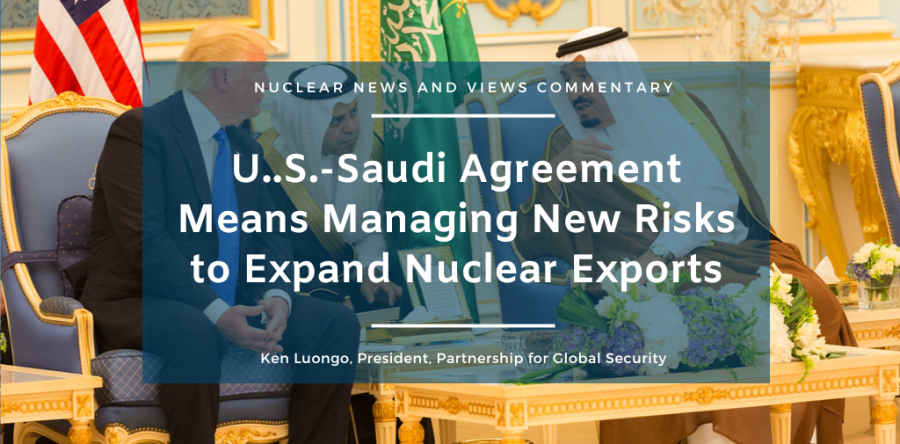
The U.S.-Saudi nuclear cooperation agreement that now sits before Congress will open a critical nuclear market to American nuclear technology but it also contains provisions that create concerns about potential future security hazards. In this new nuclear world effective competition requires managing these risks, not avoiding them.
Reactor Competition
The U.S. has not constructed any power reactors in the Middle East, but Russia is building them in Turkey and Egypt. China has submitted a bid for the Saudi reactors. And South Korea has inked several bilateral nuclear energy agreements with Saudi Arabia.
In 2009, the U.S. and United Arab Emirates (UAE) reached a "gold standard" bilateral nuclear agreement that some suggest the U.S.-Saudi deal should mimic. But the gold standard conditions are not the norm for U.S. nuclear cooperation agreements. And the UAE reactors were awarded to South Korea, not America.
This history underscores the market opportunity competitor nations see in the region and the challenges for America to enter it.
A Litmus Test
The U.S.-Saudi nuclear cooperation agreement is a litmus test for American political leaders’ commitment to the national nuclear energy resurgence that has been a bipartisan political priority for the past decade.
International nuclear market competition is intense with China and Russia having a head start and inherent advantages. Beyond the sale of Westinghouse AP-1000s to Saudi, the congressional decision on the bilateral agreement will impact control of the future nuclear market for Small Modular Reactors (SMR) and microreactors.
The U.S. government and private investors have poured billions of dollars into these new types of reactors, and because their fuel, coolant, and operation don’t conform to the existing reactor standard they will not be governed by the old rules. These small reactors are increasingly of interest to emerging economy nations, most of which possess little nuclear experience, requiring evolving nuclear cooperation agreements, technologies, and policies. The U.S. can’t lead this governance evolution from behind.
Congressional Considerations
The two issues causing controversy are uranium enrichment on Saudi territory and a U.S.-centric safeguards system that will substitute for the IAEA’s intrusive Additional Protocol.
Uranium Enrichment
Uranium enrichment is the most difficult issue for Congress because America and its allies have spent decades developing barriers to the export of sensitive dual use nuclear fuel technologies to prevent the potential production of nuclear weapons.
The U.S.-Saudi agreement seems to acknowledge the sensitivity and history of the uranium enrichment issue and seeks to provide an air gap around any potential plant, through joint assessments and ultimately U.S.-control of the facility to protect sensitive technology.
Congressional consideration of the uranium enrichment provision cannot ignore previous statements by Saudi Crown Prince Mohammed bin Salman and other high-level officials that the kingdom will seek nuclear weapons if Iran produces them. These are troubling comments that were directly linked to Iran’s escalating nuclear activities.
Iran’s program has now been dramatically degraded due to U.S. and Israeli bombing. And for the first time in 20 years, the IAEA referred Iran to the United Nations Security Council for "noncompliance" with its nonproliferation obligations. Those are major hindrances to Iran’s once torrid nuclear activities, and the Saudis should seize the high ground against their damaged rival and set a precedent for never enriching uranium for nuclear weapons.
Safeguards Substitution
The other major concern raised by the agreement is safeguards and security. The agreement requires IAEA safeguards at declared nuclear facilities in Saudi Arabia. But it does not include the Additional Protocol that allows for snap inspections at undeclared facilities.
The Additional Protocol would be supplanted by a bilateral U.S. Saudi inspection regime, and here has been criticism of this arrangement. But the reality is that the U.S. national laboratories are deep repositories of safeguards expertise and U.S. inspectors and technology are at a minimum equally capable to their international counterparts.
Further, the IAEA’s Secretary General, Raphael Grossi, has stated that while the Additional Protocol would be the “ideal setup…it has been possible to introduce a number of provisions to the bilateral agreement that will give the agency additional verification and monitoring authorizations.” These are “capacities which are very, very similar to those that you may find in an Additional Protocol.”
Global Realities
Should the agreement be approved, the U.S. will not be going it alone in Saudi Arabia. The construction of any Westinghouse AP-1000 reactor has many partners, and none more important that South Korea. Korea’s success in constructing the UAE reactors could allow its industry to play a major role in the construction of the Saudi reactors, and Korean companies will provide significant component content for the AP-1000. This arrangement could set the stage for additional joint nuclear projects as part of the $350 billion tariff agreement under which South Korea will invest in U.S. energy.
The U.S. also is sensitive to how the agreement with the Saudi’s may impact other countries in the region, with President Trump tacking on a last minute obligation that the kingdom normalize relations with Israel before the bilateral agreement can be implemented.
Overall, the U.S.-Saudi deal is the harbinger of the movement beyond past nuclear cooperation precedent. It is a response to an evolving nuclear technology and export landscape that requires effective adaptation to new risks. It is a challenge to American political leaders, and they must determine whether they want the U.S. to lead the new nuclear energy order or stay on the sidelines.
Ken Luongo, President, Partnership for Global Security