
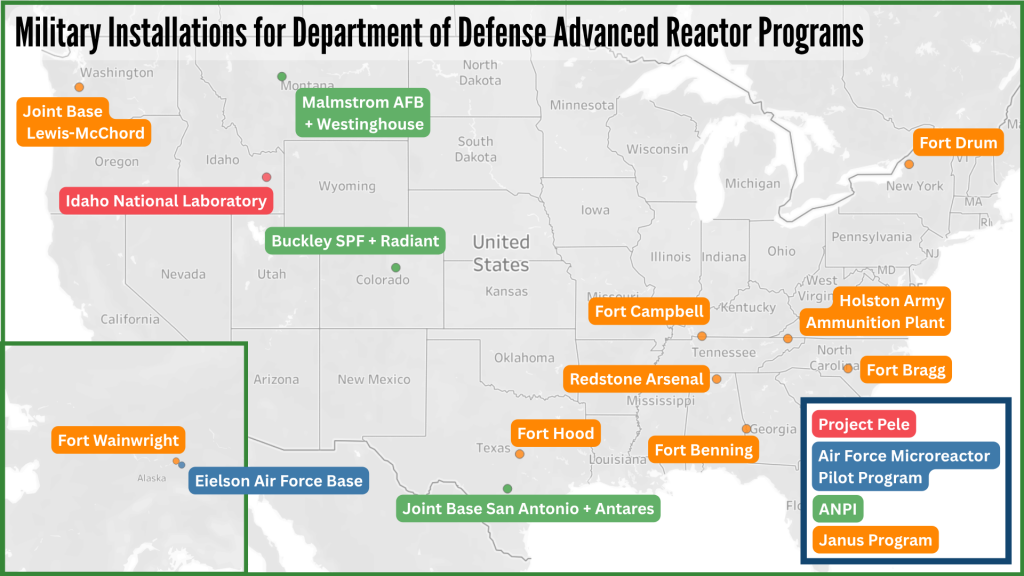
The Department of Defense (DoD) has been pursuing advanced terrestrial nuclear power for military installation energy and mobile applications since it was recommended by the Defense Science Board a decade ago. These efforts have accelerated under the Trump Administration's push for American energy dominance and there are now four key DoD programs. The map identifies where demonstrations of these advanced nuclear technologies will occur.
Project Pele: Formally launched in 2020, Project Pele aims to design, build, and demonstrate a prototype for a portable microreactor (1-5 MWe) with long-duration operations without refueling, utilizing TRISO fuel, for deployment at remote military installations. The Pele demonstration will take place at Idaho National Laboratory (INL) and is targeted for 2028. In June 2022, Project Pele awarded BWXT a $300 million contract to construct its 1.5 MWe high-temperature gas-cooled reactor prototype. BWXT also received a $37 million contract from INL to fabricate TRISO fuel for Project Pele’s core. In September 2024, DOD and BWXT announced that they had broken ground at INL for the Project Pele microreactor. BWXT has begun construction on the reactor core and has completed fabrication of TRISO fuel using high-assay low-enriched uranium (HALEU) at its fuel fabrication facility in Lynchburg, Virginia. Fuel was successfully delivered to INL in December 2025.
Department of the Air Force Microreactor Pilot Program: In September 2022, the Department of the Air Force (DAF) launched its own microreactor pilot program in response to congressional direction in the FY2019 National Defense Authorization Act (NDAA). The DAF plans to execute a 30-year power purchase agreement (PPA) with a third-party vendor who will construct, own, operate, maintain, and decommission a commercial microreactor (less than 5 MWe) licensed by the Nuclear Regulatory Commission (NRC) to deliver electricity and thermal energy to an Air Force or Space Force installation. In 2023, DAF issued Oklo a Notice of Intent to award a contract to provide a stationary microreactor for Eielson Air Force Base in Alaska, pending commercial licensing from the NRC.
Advanced Nuclear Power for Installations (ANPI): Launched in June 2024, the Defense Innovation Unit, Army, and Air Force aim through ANPI to field fixed, on-site microreactor systems capable of supplying 100% of critical load requirements (target 3-10 MWe capacity), promote rapid prototyping through flexible, milestone-based Other Transaction Agreements (OTAs). Regulatory approval will proceed via civilian NRC pathways, with support from DoE national labs. ANPI proposes to shift to Power Purchase Agreements upon successful completion of the program, wherein the reactor would be Commercially Owned and Operated (COCO) on land leased from the military.
In April 2025, DoD announced eight companies as eligible to proceed under the ANPI program: Antares Nuclear, BWXT, General Atomics, Kairos, Oklo, Radiant, Westinghouse, and X-energy. On April 22, 2026, the Air Force announced that the following companies will develop and operate their reactor prototype projects, ideally transitioning to providing power to military installations:
- Radiant Industries will be paired with Buckley Space Force Base in Colorado to develop its 1 MWe Kaleidos high-temperature gas-cooled (helium-cooled) reactor. As a participant in the DOE's Reactor Pilot Program, Radiant is targeting criticality by July 4th. It is slated to conduct testing at INL's Demonstration of Microreactor Experiments (DOME) facility this year. Standard Nuclear has signed an OTA through the DOE's Fuel Line Pilot Program to supply Radiant with TRISO fuel at INL.
- Westinghouse will be paired with Malmstrom Air Force Base in Montana to develop its 5 MWe eVinci passive heat pipe, "nuclear battery" style reactor. The eVinci will also utilize TRISO fuel. Westinghouse will have the opportunity to test at DOME after Radiant.
- Antares Nuclear will be paired with Joint Base San Antonio in Texas to develop its 0.5 MWe R1 graphite moderated, sodium heat-pipe cooled microreactor utilizing TRISO fuel.
The ANPI initiative seeks to have at least one advanced nuclear reactor operating on at least one DAF installation by 2030 or sooner. Next steps include siting and environmental analyses.
Janus Program: In May 2025, President Trump issued Executive Order 14299 on Deploying Advanced Nuclear Reactor Technologies for National Security, which directs DoD, through the Army, to commence operation of an Army-regulated nuclear reactor at a domestic military base or installation no later than September 30, 2028. In response, the Army announced it was launching the Janus Program on October 14, 2025, and in November opened a solicitation for microreactor proposals. Through the Janus Program, the Army seeks to prototype solutions for ‘Microreactor Power Plants (MPPs)’ that can be installed at military sites or deployed flexibly for mobile operations. Selected vendors will build two prototypes: a first-of-a-kind (FOAK) prototype and subsequently (drawing from lessons learned for FOAK efforts) a second-of-a-kind (SOAK) prototype. Upon successful completion of the prototyping activity, the Army plans to enter into follow-on agreements with vendors to purchase power and/or scale MPP production.
Dr. Jeff Waksman, Principal Deputy Assistant Secretary of the Army for Installations, Energy and Environment, who also led Project Pele, is currently overseeing the Janus program and in a recent interview, mentioned that the military is overwhelmingly pursuing gas-cooled or heat-pipe designs, which are far more conducive to rapid deployment and transportability than light water or molten salt reactors. The key challenge with these microreactors, he described, is wear and tear on the reactor materials. Waksman also discussed the preference for tri-structural isotropic (TRISO) fuel. Because TRISO fuel pellets are coated and resistant to meltdown, acting as a sort of containment, the theory is that a reactor would need less concrete shielding, reducing construction costs and making the reactor more transportable. Additionally, although TRISO is less efficient due to its lower uranium density, it minimizes volatile dispersion in case of a shutdown and is considered “walk away safe,” requiring fewer operators.
Cate Donovan, Della Ratta Fellow, Partnership for Global Security