
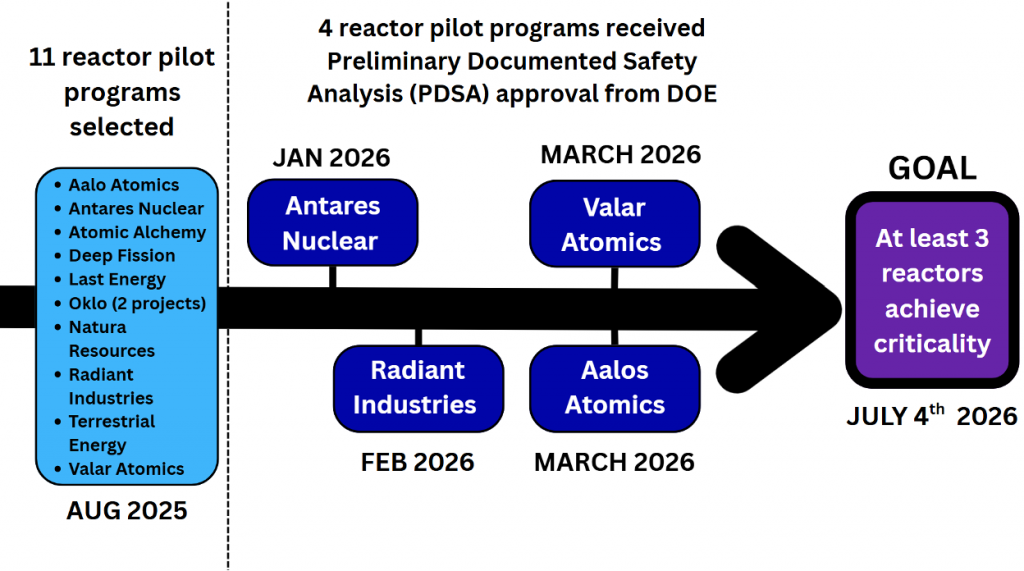
The program requires the participating companies to fund the cost of the testing, but it allows them to bypass the Nuclear Regulatory Commission approval process in the initial testing phase. DoE is the authority responsible for the reactor approval. Of the 11 advanced reactor designs selected for the program in August 2025, four have now received DoE approval for their Preliminary Documented Safety Analysis (PDSA):
- Antares Nuclear received PDSA approval in January 2026 for its Mark-0 reactor, a transportable, sodium heat pipe cooled R1 microreactor using HALEU TRISO fuel, with an output of 100 kWe to 1 MWe.
- Radiant Industries received PDSA approval in February 2026 for Kaleidos, a 1 MW helium gas cooled nuclear microreactor utilizing HALEU TRISO fuel.
- Valar Atomics received PDSA approval in March 2026 for a high-temperature, gas-cooled, graphite-moderated reactor employing HALEU TRISO fuel.
- Aalo Atomics received PDSA approval in March 2026 for the 10 MW sodium-cooled Aalo-1 reactor using low-enriched uranium dioxide fuel for the Aalo-X experimental power plant.
Receiving PDSA approval allows the reactor companies to move from concept validation to execution including final design work, site preparation, and early construction activities, while advancing toward a Final Documented Safety Analysis (FDSA) required for reactor operation. The Reactor Pilot Program represents a significant effort to revitalize the U.S. nuclear industry and meet growing energy demand. It has drawn both praise and criticism for its aggressive schedule.
Gabriela Zanko, Della Ratta Fellow, Partnership for Global Security