
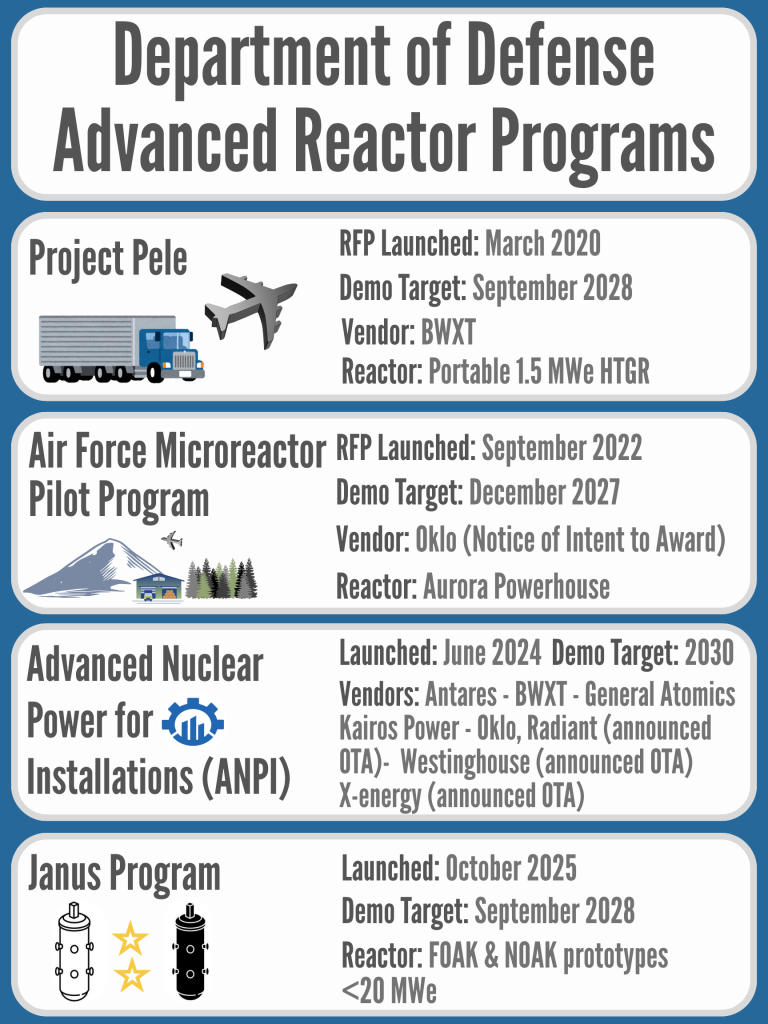
Traditionally, the Navy has been the military service most associated with nuclear power, as it is used as propulsion in a variety of naval vessels. But the other services have been engaged in nuclear power activities in the past. In recent years, that activity has significantly expanded and now the Army, Air Force, and Office of the Secretary of Defense are all pursuing the development of small nuclear reactors for both military base power and as a transportable power source to support overseas deployments. Much of this work grew out of direction in the FY19 defense bill to identify potential locations to site, construct, and operate a microreactor by the end of 2027. The infographic offers an overview of the major programs.
Project Pele is administered by the Strategic Capabilities Office (SCO) in collaboration with the Army and Department of Energy (DOE). The goal of the program is to design, build, and demonstrate a prototype for a portable microreactor of 1.5 Mwe power, utilizing TRISO fuel, for deployment at remote military installations. Initial investigations of the technology included the Westinghouse eVinci, X-energy XENITH, and a BWXT microreactor. Ultimately, BWXT won a contract for the mobile reactor design. It broke ground at Idaho National Lab in September 2024. In December 2025, BWXT-manufactured TRISO fuel was delivered to INL.
The Air Force Microreactor Pilot Program, administered in partnership with the Defense Logistics Agency Office of Energy, is designed to develop a commercial microreactor of up to 5 MWe power that can be licensed by the Nuclear Regulatory Commission (NRC) to deliver electricity and thermal energy to an Air Force or Space Force installation. The goal is to establish a 30-year power purchase agreement (PPA) with a third-party vendor, who will construct, own, operate, maintain, and decommission the reactor. Eielson Air Force Base, Alaska was chosen as the initial location to pilot the microreactor. The tentative choice for the project is Oklo’s Aurora Powerhouse liquid metal-cooled fast reactor. The Air Force issued a Notice of Intent to Award this contract pending NRC licensing of the reactor. Oklo is in preapplication activities with the NRC for its commercial Aurora Powerhouse design.
The Advanced Nuclear Power for Installations (ANPI) program was launched in 2024 as a collaboration between the Defense Innovation Unit and the Army and Air Force. It aims to field commercially available, fixed nuclear microreactor power systems for continuous, reliable power generated on-site at military installations, ideally within a 3-10 MWe capacity range. Participating vendors include Antares Nuclear, BWXT Advanced Technologies, General Atomics Electromagnetic Systems, Kairos Power, Oklo, Radiant Industries, Westinghouse, and X-energy. The project is now in the prototyping phase. The program utilizes Other Transaction Authority (OTA) agreements and milestone-based contracting vehicles that bypass traditional procurement timelines. To stimulate the domestic commercial advanced nuclear industry and supply chains, regulatory approval is to proceed via civilian NRC pathways, with support from Department of Energy national labs.
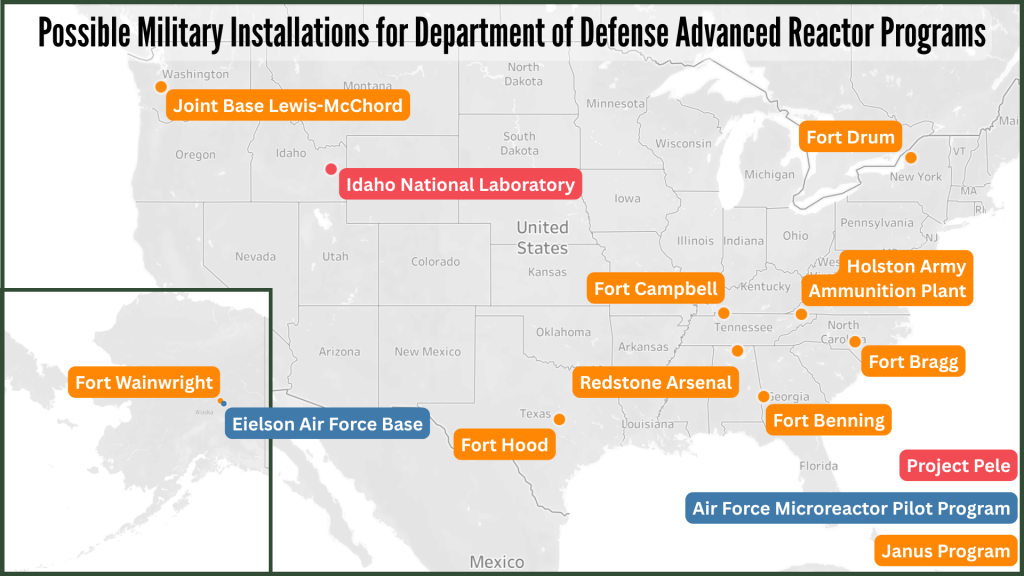
The Janus Program is the most recent military microreactor initiative, having been launched in October 2025. It is administered by the Army and the Defense Innovation Unit. It aims to deploy commercially owned and operated microreactors of 1-20 MWe power for use on domestic military installations no later than Sept. 30, 2028. So far, no reactor vendors have been chosen. In November 2025, the Army identified 9 sites for potential deployment which can be seen on the map.
Cate Donovan, Della Ratta Fellow, Partnership for Global Security
Ken Luongo, President, Partnership for Global Security